 CrateLog
Which pressing do I have? How to read matrix and runout numbers
The matrix or runout number is the code etched or stamped into the smooth band of vinyl between the last track and the label, called the runout groove or dead wax. It identifies the master the record was pressed from, so it is usually the most reliable way to tell one pressing from another. To identify yours, read the code on both sides and compare it with the Matrix / Runout entries listed for each version on Discogs.
Where to find it
Look at the shiny, groove-free ring between the end of the music and the paper label, on both sides. The code is small and usually not printed in ink, so it's easy to miss:
- Tilt the record under a light. A lamp or the phone's flashlight held at a low angle makes the etching stand out.
- It may be hand-written or machine-stamped, and often both: a stamped number next to scratched initials or a short message.
- Each side has its own code, often the same base number with a different side marker.
Write down everything you can see on each side, exactly as it appears, including letters that look like stray marks. Note crossed-out codes too: they can mean a lacquer was re-used or re-numbered, and Discogs listings often record them.
What the parts usually mean
There is no single standard: labels, countries and pressing plants each used their own systems. A runout might read something like this:
Common parts are:
| Part | Example | What it usually tells you |
|---|---|---|
| Matrix number | ABC-1234 | Often built from the catalog number. Identifies the release and the side. |
| Side marker | A / B, 1 / 2 | Which side of the record this is. |
| Cut or lacquer number | -1, A1, 1A | On many labels, which lacquer (cutting) or stamper was used. A higher number often means a later cut, but the convention varies. |
| Mastering marks | STERLING, RL, Porky Prime Cut | The mastering studio or engineer who cut the lacquer. |
| Plant marks | a logo, letters or a symbol | The pressing plant, which can separate an original from a pressing made elsewhere. |
| Stamper or mother codes | small numbers or letters, often stamped | On some pressings, which metal parts in the chain the record came from. |
The useful part isn't decoding every character, it's that two pressings with the same catalog number often have different runouts, and that difference is what Discogs uses to list them as separate versions.
How to match it on Discogs
- Find the release by its catalog number or by artist and title, and open the master release's list of versions.
- Open a candidate version and scroll to Barcode and Other Identifiers. The runouts are listed per side, as in Matrix / Runout (Side A).
- Compare your notes character by character. A single different letter, cut number or mastering mark means a different version.
- Repeat for the other candidates until one matches both sides.
Typing part of the runout into the Discogs search box sometimes finds the release directly, which helps when the catalog number gives too many results.
When the runout isn't enough
Some versions share the same runout and differ elsewhere, and some runouts are too worn or faint to read. Check the other places where pressings usually differ:
- The label: design, colour, the small print around the edge, a Made in … line, the rights society text.
- The back cover: the address, the printer's credit, the barcode area, a price code.
- The inner sleeve: plain, printed or company sleeve, which often changes between pressings.
- Stickers: a hype sticker on the shrink wrap, or a price or distributor sticker.
Let CrateLog point you to the difference
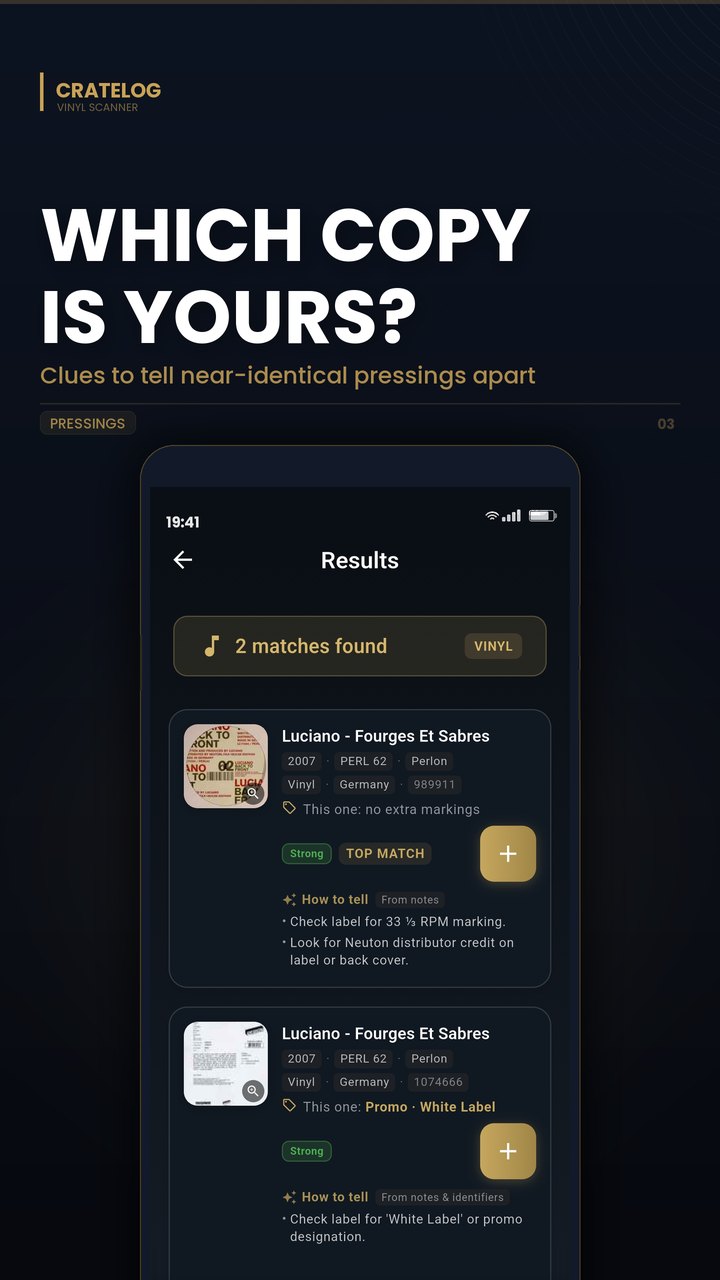
Comparing every version by hand is the slow part. With CrateLog, scan the center label and look at the candidates it finds. When several pressings look nearly identical, each one shows How to tell clues: what to check, and where, to know which copy you have. The clues cover the label text, the back cover, the inner sleeve, stickers and the matrix/runout.
When only the runout separates them, CrateLog says so: Matrix / runout is needed to tell these variants apart. Then you read the etching on your copy, using the steps above, and pick the match.
Questions
What is the difference between a matrix number and a catalog number?
The catalog number is the label's code for the release, printed on the label and sleeve, and every copy of that release shares it. The matrix or runout number is etched or stamped into the vinyl itself, and can differ between pressings with the same catalog number.
Where is the matrix number on a vinyl record?
In the runout groove, the smooth ring between the last track and the label, on each side. Tilt the record under a light to read it.
How do I know if I have a first pressing?
There's no single rule. Look for the identifiers that match the earliest version of the release on Discogs, the label design used at the time of the original release, and, on labels that number their cuts, the lowest lacquer or stamper numbers. Check the notes on the Discogs release page, where collectors often record what separates an original from early repressings.
Why are the codes different on side A and side B?
Each side is cut and pressed from its own lacquer and stamper, so each carries its own code, usually the same base number with a different side marker.
Do CDs have matrix numbers too?
Yes. They're on the clear inner ring of the disc, often alongside short IFPI codes that identify the mastering facility and the mould. Discogs lists them under the same Barcode and Other Identifiers section.